
Most vulnerability programs still rank work by CVSS score, scanner severity, or whichever dashboard is loudest that week. In practice, defenders should prioritize what is being actively exploited. CISA’s Known Exploited Vulnerabilities (KEV) Catalog is one of the cleanest public signals for real-world attacker activity, and it is useful far beyond US federal agencies.
As of this writing, the KEV catalog contains 1583 entries. If your team does not have a KEV-first lane in patch management, you are likely spending time on theoretical risk while adversaries exploit known paths in the wild.
What “KEV-first” means operationally
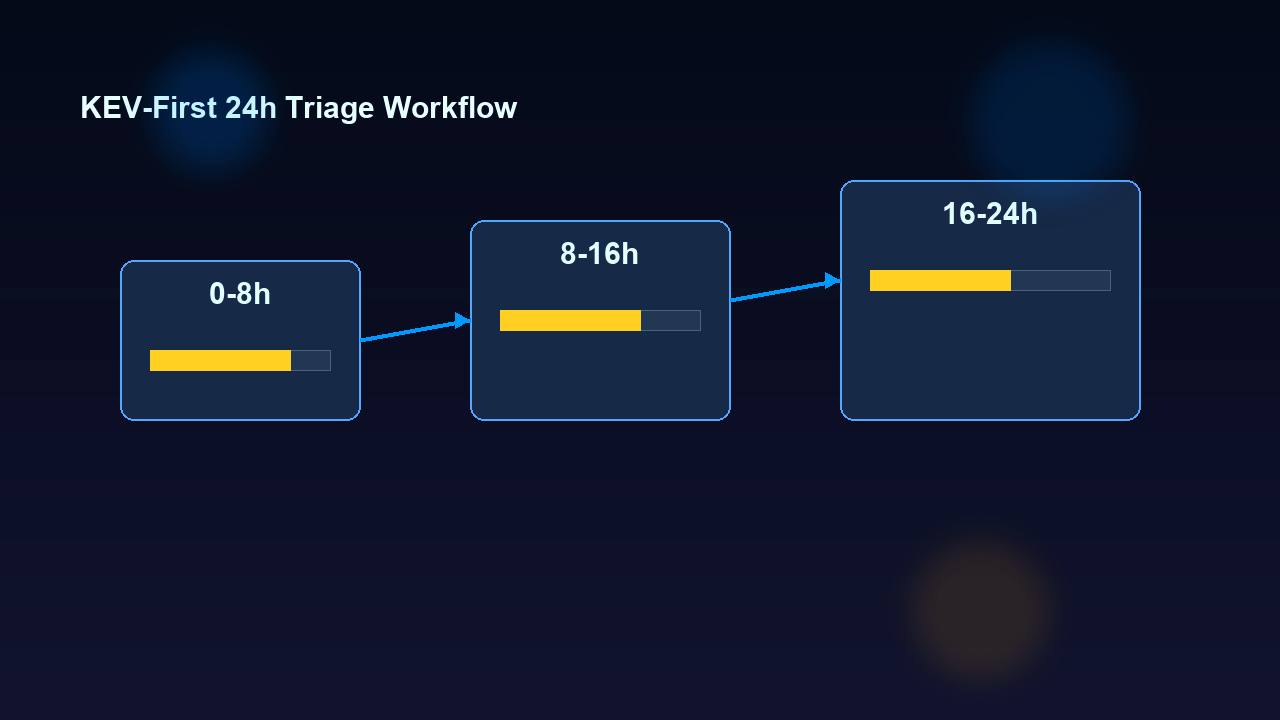
A KEV-first workflow does not replace your normal vulnerability management lifecycle. It adds a high-priority stream with strict SLAs:
- P0 (24h target): Internet-exposed or identity/control-plane assets affected by KEV-listed CVEs
- P1 (72h target): Internal critical assets with direct privilege impact
- P2 (7 days): Remaining affected systems with compensating controls
Start with four questions:
- Do we have this product/version?
- Is the vulnerable service exposed or reachable by likely adversaries?
- Is exploit telemetry or suspicious activity already visible?
- Can we patch immediately, or do we need temporary mitigations?
Quick implementation: KEV ingestion + asset matching
Pull KEV daily and map it to your asset inventory (CMDB, EDR, cloud resource graph, vulnerability scanner export). Here is a minimal Python starter:
import requests, json
kev = requests.get("https://www.cisa.gov/sites/default/files/feeds/known_exploited_vulnerabilities.json", timeout=30).json()
kev_cves = {v["cveID"] for v in kev["vulnerabilities"]}

with open("findings.json","r",encoding="utf-8") as f:
    findings = json.load(f)

priority = [f for f in findings if f.get("cve") in kev_cves]
print(f"KEV matches: {len(priority)}")
If you are a Microsoft-heavy shop, add Graph/Defender exports and tag impacted devices automatically for emergency remediation waves.
Detection engineering: don’t wait for patch completion
Patching is necessary, but not sufficient. For every KEV item affecting your environment, create temporary detections and hunt queries tied to known exploit behavior. Use ATT&CK techniques as a bridge between CVE bulletins and SOC logic.
- Public-facing appliance exploitation: monitor unusual admin logins, config export events, web shell indicators, and post-auth process execution.
- Identity stack CVEs: monitor impossible travel + risky sign-ins + sudden consent grants or token abuse patterns.
- RCE in server middleware: hunt child processes from service accounts, suspicious PowerShell/Bash chains, and outbound beaconing from newly exploited hosts.
Hardening and containment checklist (when patching is delayed)
- Restrict exposure: temporary ACLs, geo/IP allowlists, VPN-only admin paths
- Disable vulnerable features/modules per vendor guidance
- Rotate credentials/secrets accessible from the vulnerable component
- Segment management interfaces away from user networks
- Increase log retention for affected systems to support IR backtracking
- Pre-stage IR actions: isolation scripts, account disable runbooks, emergency comms
Leadership metrics that matter
- Mean time to KEV remediation by business unit
- % KEV exposure on internet-facing assets
- % KEV items with active detections deployed within 24h
- Exceptions older than SLA with explicit risk acceptance owners
Recent KEV examples (snapshot)
- D-Link DIR-823X — CVE-2025-29635 (added 2026-04-24)
- Samsung MagicINFO 9 Server — CVE-2024-7399 (added 2026-04-24)
- SimpleHelp SimpleHelp — CVE-2024-57728 (added 2026-04-24)
- SimpleHelp SimpleHelp — CVE-2024-57726 (added 2026-04-24)
- Marimo Marimo — CVE-2026-39987 (added 2026-04-23)
Action plan for this week
- Automate KEV feed pull and CVE normalization.
- Join KEV CVEs with asset inventory and exposure context.
- Enforce a KEV emergency patch SLA (24h/72h tiers).
- Deploy temporary detections for each high-impact KEV match.
- Report KEV-specific MTTR weekly to leadership.
Defenders win by reducing attacker dwell time and available exploit paths. A KEV-first lane is one of the fastest, most practical upgrades you can make to an existing vulnerability program.
References
- CISA Known Exploited Vulnerabilities Catalog
- CISA KEV JSON Feed
- MITRE ATT&CK
- NIST Cybersecurity Framework
- Microsoft Security Documentation